Practical AI in education cuts teacher admin time
Reflections from the Learn Sheffield AI in Education conference, exploring the changing role of teachers, educational leadership, and the future of learning.
Imagine a primary school teacher sitting at her kitchen table on a Sunday evening.
It is approaching nine o’clock. She has lessons to prepare, assessments to mark and resources to differentiate for the week ahead. She opens an artificial intelligence application and, within thirty seconds, generates a lesson plan that might previously have taken an hour.
Impressed, she asks another question.
This time, the technology produces something confidently and completely wrong.
These two experiences, separated by perhaps sixty seconds, capture one of the most fascinating challenges facing education today.
Artificial intelligence is simultaneously extraordinary and unreliable. It can reduce workload, expand creativity and democratise access to knowledge. Yet it can also introduce misinformation, reinforce prejudice and undermine independent thinking.
At the Learn Sheffield AI in Education conference, presentations from Catherine Moore, Andrew Yeomans, Dr Jim Marchang of Sheffield Hallam University and educators working within Sheffield schools explored these contradictions.
What emerged was something considerably more interesting than a discussion about technology.
It was a discussion about human intelligence, professional judgement, organisational change and what it actually means to learn.
1. The Jagged Technological Frontier
Catherine Moore introduced a concept that deserves to become part of every school leader’s vocabulary: the jagged technological frontier.
We tend to imagine technological progress as a straight line. Every year, computers become faster, software becomes better and machines become more capable.
Artificial intelligence does not behave quite like that.
It can perform an extraordinarily complex task while failing at something apparently straightforward. It can construct a sophisticated explanation of a scientific concept and then introduce an entirely fictional fact.
The frontier between what AI can and cannot do is jagged. More importantly, that frontier is often invisible until we encounter it.
For educators, this creates several significant risks:
Inaccurate and misleading information.
Bias within generated content.
Data privacy and confidentiality.
Inappropriate use by pupils.
Copyright and intellectual property.
Excessive dependence on technology.
Schools must be particularly careful about entering personal information into AI systems. They should use appropriately approved tools, supervise age-appropriate pupil use and respect pupils’ intellectual property.
But there is another risk, arguably more subtle than the others.
Cognitive offloading.
When we delegate thinking to a machine, are we removing unnecessary work, or are we removing the very activity through which learning takes place?
A teacher using AI to format a document might be saving valuable time. A pupil using AI to construct an argument they were supposed to develop independently might be avoiding the most important part of the educational experience.
The same technology. Two fundamentally different consequences.
The question is not simply whether AI is intelligent enough to enter the classroom.
It is whether we are intelligent enough to recognise when it belongs there.
2. The Missing Teacher: Rethinking Cover Lessons
There is a particular problem in education that rarely attracts national headlines.
A teacher goes on long-term sick leave. The school arranges cover, but the replacement is not necessarily a subject specialist. Over several weeks, a carefully constructed scheme of learning begins to lose its coherence.
The children are being supervised.
But are they still learning?
Artificial intelligence presents an interesting opportunity.
By working from an existing scheme of learning, AI can help teachers develop meaningful cover lessons, supporting explanations, classroom activities and assessments that a non-specialist could deliver following professional review.
This becomes particularly interesting in one-form-entry primary schools.
Imagine being the only Year 4 teacher in a school. There is no parallel Year 4 classroom. Nobody else is preparing precisely the same curriculum for children of precisely the same age.
The teacher is, in some respects, professionally isolated.
AI can become an additional planning partner.
Through platforms such as Learner Journey, existing curriculum documents can be transformed into structured learning pathways, assessments and supporting educational resources.
Knowledge that previously existed across folders, documents and individual teachers’ experience can become more accessible.
However, an important distinction emerged during Catherine Moore’s presentation.
Faster does not necessarily mean better.
Creating thirty worksheets in thirty seconds is technologically impressive. Creating one worksheet that genuinely advances a child’s understanding is educationally impressive.
We should not confuse the two.
The greatest opportunity for artificial intelligence in schools might not be doing more things.
It might be doing the important things more consistently.
3. The Art of Asking Better Questions
Consider two teachers using exactly the same artificial intelligence system.
The first types:
Create a mathematics lesson.
The second explains the year group, the curriculum objectives, the children’s prior knowledge, the common misconceptions, the lesson duration and the differing needs of pupils.
Both teachers are using the same underlying technology. Yet their experiences are likely to be remarkably different.
Why?
Because the second teacher has provided context.
Artificial intelligence introduces an interesting paradox. The quality of the answer often depends on the intelligence with which we ask the question.
During the practical sessions at Learn Sheffield, several useful principles emerged:
Be specific about desired outcomes.
Provide relevant background and examples.
Explain the intended audience.
Specify constraints and requirements.
Ask AI to improve prompts.
Evaluate and refine every response.
One particularly useful technique is asking artificial intelligence to construct the prompt itself.
Explain what you want to achieve. Ask the system what additional information it needs. Allow it to help you formulate a better instruction.
Personalisation settings can also make AI more useful. Teachers can establish preferences around UK English, educational terminology, formatting, curriculum expectations and the types of responses they find most helpful.
Approved enterprise-grade AI environments can provide additional organisational controls, although schools must still assess their particular data protection arrangements.
Prompting is becoming a form of professional literacy.
For generations, education has placed considerable emphasis on knowing the answers.
Perhaps one of the most valuable skills in an age of abundant answers will be knowing how to ask exceptional questions.
4. From Chatbots to Digital Colleagues
The first generation of generative artificial intelligence was predominantly conversational.
You asked a question. It provided an answer. You copied that answer into another application and continued working.
The next generation is increasingly operational.
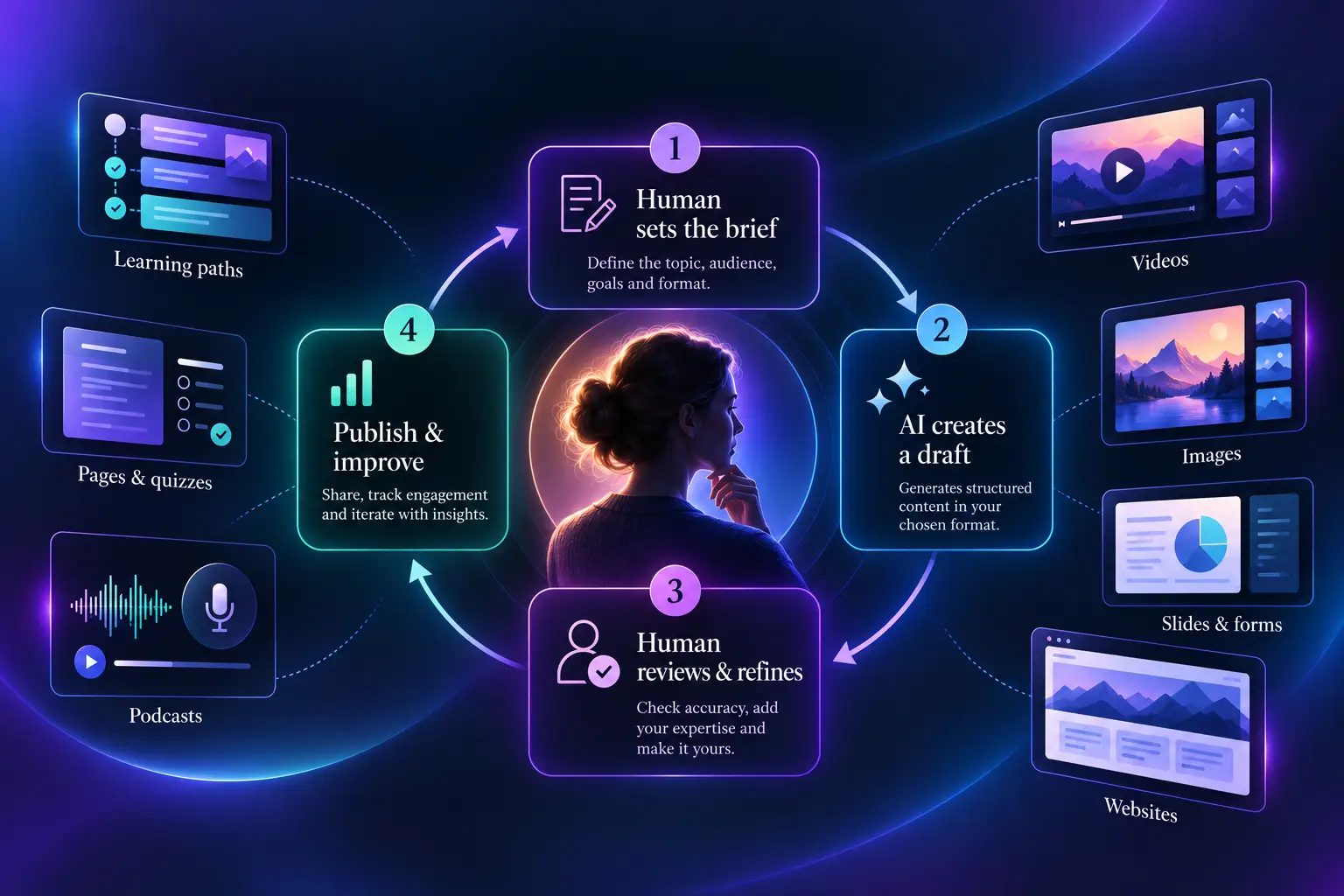
Instead of asking artificial intelligence how to perform a task, we can increasingly instruct an AI agent to undertake parts of the task itself.
This is the emergence of agentic AI.
The implications for education are considerable.
Imagine a digital agent that helps a teacher prepare weekly curriculum resources, create assessment questions, adapt materials for different reading levels and organise those materials into a structured learning programme.
Or imagine a SEND coordinator developing SMART targets. An appropriately governed workflow could turn anonymised observations into draft measurable objectives, ready for professional review.
A school improvement leader might provide a collection of safeguarding documents and ask an agentic learning platform to construct a staff development programme, complete with learning materials, assessments and supporting resources.
At Learner Journey, we are developing this approach to educational technology through AI-powered learning pathways, assessments, website creation, events and personalised tutoring.
The objective is to move beyond simply generating content towards accomplishing meaningful educational outcomes.
The distinction is fundamental.
A chatbot answers a question. An agent works towards an outcome.
However, greater autonomy introduces greater responsibility.
Schools need appropriate permissions, approval mechanisms, safeguarding controls, data protection and clear lines of accountability.
The teacher remains responsible.
What changes is the machinery through which the work gets done.
5. The Economics of Personalised Education
For decades, teachers have faced an almost impossible mathematical problem.
Thirty children.
Thirty different combinations of knowledge, confidence, motivation, experience and ability.
One teacher. One hour.
Differentiation has always been desirable. The difficulty has been delivering it consistently at scale.
Artificial intelligence changes the economics of differentiation.
A teacher can take a single piece of text and produce alternative reading levels, supporting explanations, extension activities and questions that explore common misconceptions.
Consider the humble hinge question.
A well-designed question midway through a lesson can reveal whether children have genuinely understood a concept or merely memorised a procedure.
AI can assist teachers in generating these questions, including plausible incorrect answers that expose particular misunderstandings.
Structured peer assessment offers another opportunity. Pupils can evaluate one another’s work against clear criteria, developing their understanding while potentially reducing some of the teacher’s marking burden.
Through Learner Journey, educators can create structured learning pathways, differentiated educational experiences and assessments designed around particular learning objectives.
However, personalisation must not become a mechanism for lowering expectations.
Nor should an algorithm determine what a child is capable of achieving.
The purpose of differentiation is not to create thirty separate definitions of success. It is to give thirty children meaningful routes towards ambitious learning outcomes.
For generations, personalised education has been constrained by the availability of human time.
What happens when technology begins to loosen that constraint?
6. When Technology Moves Faster Than Research
Imagine conducting a three-year research project into a technology that changes substantially every three months.
By the time the research is published, the technology originally evaluated may no longer exist in the same form.
This is one of the most significant challenges facing educational research.
Andrew Yeomans’ presentation at Learn Sheffield explored the relationship between evidence, technological change and school improvement.
The Department for Education’s principles for evidence-informed policymaking in rapidly changing technological contexts address an important dilemma.
Schools cannot simply abandon rigorous research. But neither can they necessarily wait several years before making every decision about artificial intelligence.
Evidence must become more continuous.
Consider a school introducing AI-assisted lesson planning.
Rather than immediately rolling the technology out across the entire organisation, leaders could establish a six-week trial.
They could measure teacher workload before and after implementation, examine the quality of generated resources, identify inaccuracies and investigate whether time savings translated into meaningful educational benefits.
The school could then refine its approach.
Teacher experience, pupil outcomes, independent research, safeguarding incidents and implementation observations all contribute to an evolving understanding of effectiveness.
Traditional academic research remains essential. But schools themselves can also become active participants in gathering evidence.
The challenge is not choosing between evidence and innovation.
It is learning how to innovate while continuously producing evidence.
7. Why Some School AI Strategies Will Fail
Schools have experienced technological revolutions before.
Interactive whiteboards. Tablets. Virtual learning environments. Digital textbooks.
Each arrived with promises of transformation.
Some succeeded. Others became expensive equipment that was used in ways remarkably similar to the technologies they replaced.
The arrival of technology is rarely the most difficult part.
Changing human behaviour is.
The Education Endowment Foundation’s implementation framework offers a useful structure for schools approaching artificial intelligence.
Phase | Purpose |
|---|---|
Explore | Identify the problem |
Prepare | Establish readiness and resources |
Deliver | Implement and monitor change |
Sustain | Embed and improve practice |
The first question school leaders should ask is not which AI platform they ought to purchase.
It is which problem they are attempting to solve.
Is it excessive teacher workload? Curriculum accessibility? SEND inclusion? Assessment quality? Staff development? Pupil engagement?
Without a clearly defined problem, AI adoption risks becoming an expensive experiment.
Effective implementation requires leadership, named responsibilities, professional development, monitoring and evaluation.
It also requires the willingness to abandon approaches that are not working.
Technology is relatively easy to install.
Culture is considerably harder.
The schools that succeed with artificial intelligence may not be those with the largest technology budgets. They may be those with the greatest understanding of organisational change.
8. The Four Types of Teacher in the AI Revolution
There is a mistake organisations frequently make when introducing new technology.
They assume everybody needs the same training.
Imagine plotting every member of school staff according to two characteristics: their willingness to use artificial intelligence and their ability to use it effectively.
Four broad groups emerge.
Teacher profile | Willingness | Ability | Development need |
|---|---|---|---|
Champions | High | High | Leadership and experimentation |
Enthusiastic beginners | High | Low | Practical training and support |
Skilled sceptics | Low | High | Evidence and ethical discussion |
Reluctant beginners | Low | Low | Reassurance and foundational skills |
These groups require different approaches.
An enthusiastic early career teacher might benefit from practical examples and guidance around responsible use.
An experienced sceptic might have legitimate concerns about pupil dependency, environmental sustainability, professional identity or the reliability of generated information.
These concerns should not automatically be interpreted as resistance to progress.
Indeed, one of the most interesting implications is that AI working groups should not consist exclusively of AI enthusiasts.
The sceptic might identify the safeguarding problem the enthusiast overlooked.
The enthusiast might discover the educational opportunity the sceptic dismissed.
An effective working group needs both.
Before attempting to transform an organisation, leaders must understand the people who inhabit it.
Artificial intelligence implementation is fundamentally a human challenge.
9. The School AI Policy That Actually Gets Read
There is something peculiar about organisational policies.
The more complicated they become, the less likely the people they are intended to protect will read them.
A comprehensive school AI policy is important. But so is a concise acceptable use agreement that every teacher can understand.
The fundamental principles are relatively straightforward:
Protect pupils’ personal information.
Use approved AI applications.
Verify all generated information.
Check outputs for potential bias.
Retain human decision-making authority.
Respect copyright and intellectual property.
Report safeguarding concerns immediately.
The more interesting question is how these principles become embedded in everyday professional behaviour.
Teachers need to understand which applications are approved, what information can be entered, which activities are permitted and when additional authorisation is required.
They must also recognise that artificial intelligence products change.
A new integration, a different underlying model or a revised data-processing agreement could introduce risks that were not present when the original assessment was conducted.
An AI policy should therefore be a living document rather than something written once and placed in a folder.
Governors and trust boards must maintain oversight, while school leaders translate policy into practical behaviour.
The best AI policies achieve two seemingly contradictory objectives.
They protect people from foreseeable harm while giving professionals the confidence to experiment.
They are not barriers to progress.
They are the conditions that make responsible progress possible.
10. The Sheffield Schools Experiment: Giving Teachers Permission to Innovate
One of the most interesting ideas discussed at Learn Sheffield was not technological at all.
It was guilt.
Some teachers feel that using artificial intelligence is cheating.
Why?
Perhaps because education has historically associated effort with professional commitment.
A teacher who spends three hours creating classroom resources feels industrious. A teacher who produces comparable resources in twenty minutes using artificial intelligence might feel uncomfortable.
But suppose those additional hours could be spent supporting individual pupils, improving feedback or simply recovering from an exhausting working week.
Which teacher is behaving more professionally?
The example of Watercliffe Meadow, a Sheffield primary school with approximately 475 pupils according to the conference presentation, illustrated a practical approach to implementation.
Staff were given opportunities to experiment with approved tools, develop resources they could use immediately and observe artificial intelligence being demonstrated during professional development.
A separate case study involving Cascade MAT highlighted the importance of acceptable use agreements, approved applications, staff training and ongoing review.
According to the findings presented at the conference, 96% of staff in that case study agreed that they understood acceptable AI use.
What these examples have in common is not necessarily technological sophistication.
It is organisational permission.
Teachers need time to experiment. They need psychological safety. They need to know that their leadership supports responsible innovation.
The objective is not to replace the teacher.
It is to remove some of the obstacles preventing teachers from doing their best work.
11. Is a Three-Year-Old More Intelligent Than Artificial Intelligence?
Show a young child an apple.
Then show them a green apple, a red apple and an unfamiliar variety.
A young child can often recognise the underlying concept despite considerable variation.
Now consider an artificial intelligence system trained to classify fruit using a limited collection of images. Present it with something significantly different from its training examples and it may struggle.
During his presentation at Learn Sheffield, Dr Jim Marchang of Sheffield Hallam University used this type of contrast to challenge our assumptions about machine intelligence.
Artificial intelligence can process extraordinary volumes of information. It can identify patterns, generate explanations and make predictions at remarkable speed.
But computational capability is not necessarily equivalent to human understanding.
Consider healthcare.
An AI-generated assessment of a medical image might provide valuable evidence. But a clinician must also consider symptoms, medical history and other information before making an important treatment decision.
Education requires a similarly considered approach.
A teacher understands a child’s emotional development, learning history, relationships and individual circumstances in ways that an artificial intelligence system may not fully capture.
The teacher might recognise that a child who performs poorly on an assessment is experiencing a temporary difficulty rather than lacking the ability to understand the subject.
An algorithm may not appreciate that distinction.
Artificial intelligence should inform professional judgement, not automatically replace it.
Perhaps the most important thing children need to understand about artificial intelligence is that impressive performance should never be confused with infallibility.
12. The Six-Year-Olds Are Already Using AI
There was a particularly striking finding presented during the Learn Sheffield conference.
In one primary-school research project, approximately two-thirds of the children surveyed had already used artificial intelligence.
Almost a third were reportedly accessing it without supervision.
Even among Year 2 pupils, AI use was surprisingly common.
These were local research findings rather than national prevalence estimates. Nevertheless, they raise an important question.
The adults were debating when children should begin learning about artificial intelligence.
The children had already started using it.
There is an enormous difference between knowing how to operate something and understanding what it does.
A six-year-old might know that a chatbot answers questions without understanding where the answers come from, why they might be inaccurate or what happens to the information they provide.
AI literacy must therefore become considerably more than a technical skill.
Children need age-appropriate opportunities to understand how machines learn, why data matters, how bias emerges and why generated information requires verification.
They also need to understand the social and ethical implications of technology.
Importantly, schools do not necessarily need to provide unrestricted access to generative AI systems to teach these concepts.
We teach children road safety long before they are old enough to drive a car.
We can teach children artificial intelligence literacy before they independently operate powerful AI systems.
The danger is not simply that children are using artificial intelligence.
It is that they may be using it without understanding what they are using.
13. Teaching Children to Think in an Age of Artificial Intelligence
For most of educational history, information was relatively scarce.
Books were expensive. Libraries had limited opening hours. Access to specialist knowledge depended heavily on geography, family circumstances and the availability of teachers.
Education taught children how to acquire knowledge, remember it and use it.
Artificial intelligence introduces a different challenge.
Information is becoming abundant. Convincing explanations are available almost instantaneously. Producing a plausible essay has never been easier.
But what happens to thinking?
Cognitive offloading is not a new phenomenon.
Calculators, search engines and satellite navigation systems have all allowed humans to delegate aspects of mental activity.
The critical question is which activities we delegate.
Imagine two children attempting the same mathematics problem.
The first asks artificial intelligence for the answer and copies it into an exercise book.
The second attempts the problem independently, becomes stuck and asks artificial intelligence for a small hint. The system encourages reflection, provides an alternative explanation and presents another question to test understanding.
Both children are using AI.
Only the second is necessarily using it as part of a meaningful learning process.
The distinction is pedagogical rather than technological.
At Learner Journey, the opportunity for AI-powered tutoring is to support understanding through structured learning pathways, assessments, personalised explanations and appropriate safeguards.
A well-designed AI tutor should not simply give every answer immediately.
It should help learners develop the capacity to discover, evaluate and apply answers themselves.
An effective AI literacy curriculum must therefore combine subject knowledge, practical skills, ethical awareness and independent judgement.
The purpose of artificial intelligence in education should not be to eliminate intellectual struggle.
It should be to make productive intellectual struggle more accessible.
14. The Teacher Becomes the Architect
We may be witnessing the beginning of a new industrial era.
The Industrial Revolution changed the relationship between humans and physical labour. The computer revolution changed the relationship between humans and information.
The agentic AI revolution is beginning to change the relationship between humans and work itself.
Increasingly, professionals will not simply perform tasks. They will design workflows, instruct digital agents, evaluate outputs and manage systems that undertake parts of those tasks on their behalf.
Education will not be immune to this transition.
Imagine a teacher who no longer needs to manually transfer curriculum documents into a learning platform, construct every assessment from scratch or spend hours formatting educational resources.
Instead, the teacher describes the desired educational outcome.
An agentic platform such as Learner Journey helps construct the digital learning experience. The teacher examines the content, challenges the assumptions, improves the pedagogy and approves the result.
The teacher moves from being exclusively a producer of educational materials towards becoming an architect of educational experiences.
This does not diminish the importance of subject expertise.
It increases it.
If artificial intelligence can generate fifty different explanations of fractions, somebody still needs to recognise which explanation is most likely to help a particular group of children understand fractions.
That somebody needs knowledge, experience and professional judgement.
Artificial intelligence makes production easier.
It does not automatically make judgement easier.
15. What Should School Leaders Do Next?
Perhaps the most important lesson from Learn Sheffield is that schools do not need to solve every artificial intelligence challenge simultaneously.
They need to begin somewhere meaningful.
A practical starting point for school leaders would be to:
Establish a diverse AI group.
Identify genuine educational problems.
Agree approved AI applications.
Introduce acceptable use agreements.
Train staff according to need.
Pilot manageable AI workflows.
Measure workload and learning outcomes.
Develop age-appropriate pupil AI literacy.
Review safeguarding and data protection.
Share evidence across school networks.
Organisations such as Learn Sheffield have an important role in creating opportunities for schools to share experiences, challenge assumptions and learn from one another.
There is little value in hundreds of schools independently making precisely the same mistakes.
School improvement networks can help turn isolated experiments into collective intelligence.
The opportunity is not merely to introduce artificial intelligence into individual classrooms.
It is to build an education system capable of learning about artificial intelligence together.
The Most Human Revolution
There is an assumption underlying much of the public discussion about artificial intelligence.
It is that the more intelligent machines become, the less important human intelligence will be.
Education may demonstrate precisely the opposite.
When machines can generate information at extraordinary speed, knowing which information to trust becomes more important.
When machines can produce unlimited educational resources, knowing which resources genuinely support learning becomes more important.
When machines can answer almost any question, knowing which questions deserve to be asked becomes more important.
And when machines can undertake increasingly complex tasks, human judgement about which tasks should be delegated becomes more important.
The Learn Sheffield conference illustrated that the future of artificial intelligence in education is not simply a question of technology adoption.
It is a question of leadership, culture, pedagogy, safeguarding, professional confidence and human understanding.
At Learner Journey, our vision is to build agentic educational technology that helps educators create richer learning experiences, reduce unnecessary administrative work and make personalised learning more accessible.
But technology alone cannot determine what constitutes a good education.
That remains a profoundly human responsibility.
Perhaps, in years to come, we will look back at this period and realise that the greatest contribution artificial intelligence made to education was not teaching machines to think like humans.
It was encouraging humans to think more carefully about what thinking actually means.