How to manage AI agents to scale your team output
During the Industrial Revolution, something extraordinary happened. The relationship between people and work fundamentally changed.

Founder, Learner Journey

The biggest workforce transformation since the Industrial Revolution
During the Industrial Revolution, something extraordinary happened. The relationship between people and work fundamentally changed.
Machines took on tasks that had previously required enormous amounts of human labour. Productivity increased. New industries emerged. Entire professions were reinvented.
But the most significant change was not the invention of the machine itself. It was the ability of people to organise, manage and direct machines.
We are now entering another industrial era.
This time, the machines are intelligent. They can read, write, research, reason, create and execute tasks.
They are AI agents.
And the most valuable employees of tomorrow may not necessarily be those who do the most work. They may be those who are best at directing the work of others — including intelligent machines.
From doing the work to managing the work
Imagine three employees.
The first spends their afternoon updating a CRM system, creating training materials and publishing upcoming events.
The second uses generative AI to help write descriptions, summarise documents and generate ideas. However, they still manually transfer information between systems.
The third builds and deploys AI agents that perform many of these tasks on their behalf. They establish objectives, define permissions, review exceptions and monitor the quality of the work.
All three employees have access to technology. But only the third has fundamentally redesigned how they work.
This is the distinction between generative AI and agentic AI.
Generative AI helps you produce something. Agentic AI can take responsibility for executing a workflow within defined boundaries.
The distinction sounds subtle. Its economic implications are enormous.
Every employee becomes a manager
Historically, becoming a manager meant being given responsibility for other people.
In the agentic era, management could become a skill required by almost everyone.
Employees will increasingly need to learn how to:
Build intelligent agents.
Define objectives and instructions.
Deploy agents into workflows.
Establish permissions and boundaries.
Monitor performance and accuracy.
Intervene when things go wrong.
Continuously improve agent capabilities.
A marketing executive might manage five agents. A learning and development professional might manage ten. An operations director might oversee dozens of interconnected agentic workflows.
The workforce is no longer simply a collection of people. It becomes a combination of human intelligence and machine intelligence.
The challenge is learning how to orchestrate both.
Learner Journey: An agentic learning platform
At Learner Journey, we believe learning platforms must evolve to reflect this new reality.
Traditional learning management systems were designed for a world in which people consumed content, completed courses and demonstrated knowledge.
That remains important. But organisations now need environments where people can learn, collaborate, create and develop new ways of working with intelligent agents.
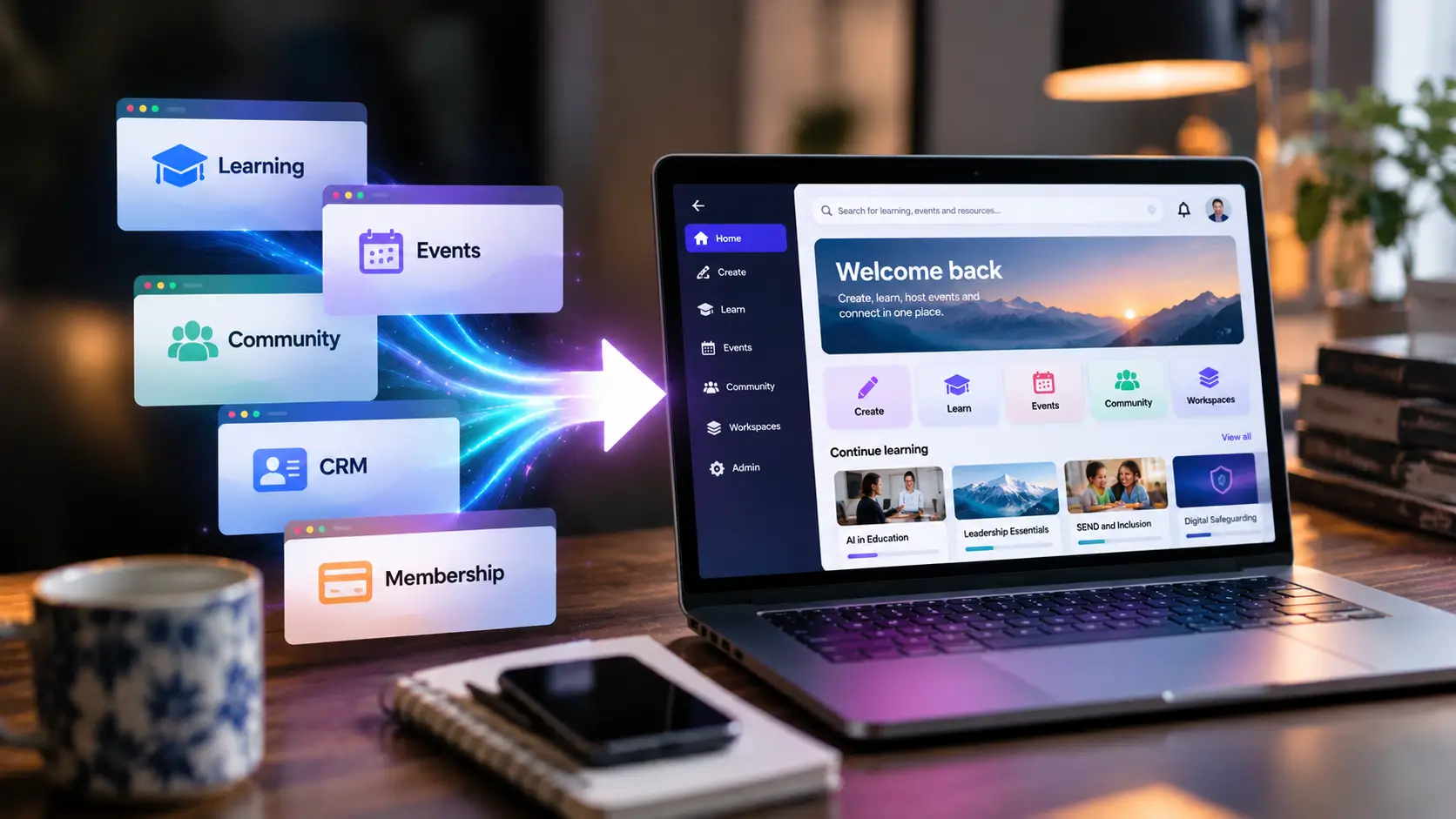
Learner Journey brings together learning communities, websites, events, learning pathways, content creation and AI-powered workflows within a shared digital workspace.
It is designed around a different question.
Rather than asking how technology can help people complete their existing work, we should be asking how technology can fundamentally change the work people need to do.
Consider four practical examples.
1. The CRM that updates itself
Imagine a salesperson who spends most of their day speaking to customers.
After every conversation, they need to update contact records, write meeting notes, change opportunity stages and schedule follow-up activities.
None of these administrative tasks directly generates revenue. Yet they are essential to running a successful sales operation.
Now imagine building an AI agent that can take meeting transcripts, identify relevant information and update the CRM through approved integrations.
The agent could:
Update customer records.
Extract commercial opportunities.
Record meeting outcomes.
Create follow-up tasks.
Flag missing information.
Prepare management summaries.
It could operate in a headless fashion, communicating directly with the CRM through its API, without the employee having to navigate multiple screens.
The salesperson becomes the supervisor of the process rather than the administrator of the system.
The human focuses on relationships, negotiation and commercial judgement. The machine handles the repetitive administration.
Multiply that across an entire sales organisation and the potential productivity gains become substantial.
2. Learning paths in minutes, not hours
Consider a learning and development professional tasked with creating an onboarding programme.
Traditionally, this might involve reviewing documents, designing a curriculum, structuring modules, writing learning objectives, creating assessments and publishing materials.
It could take days.
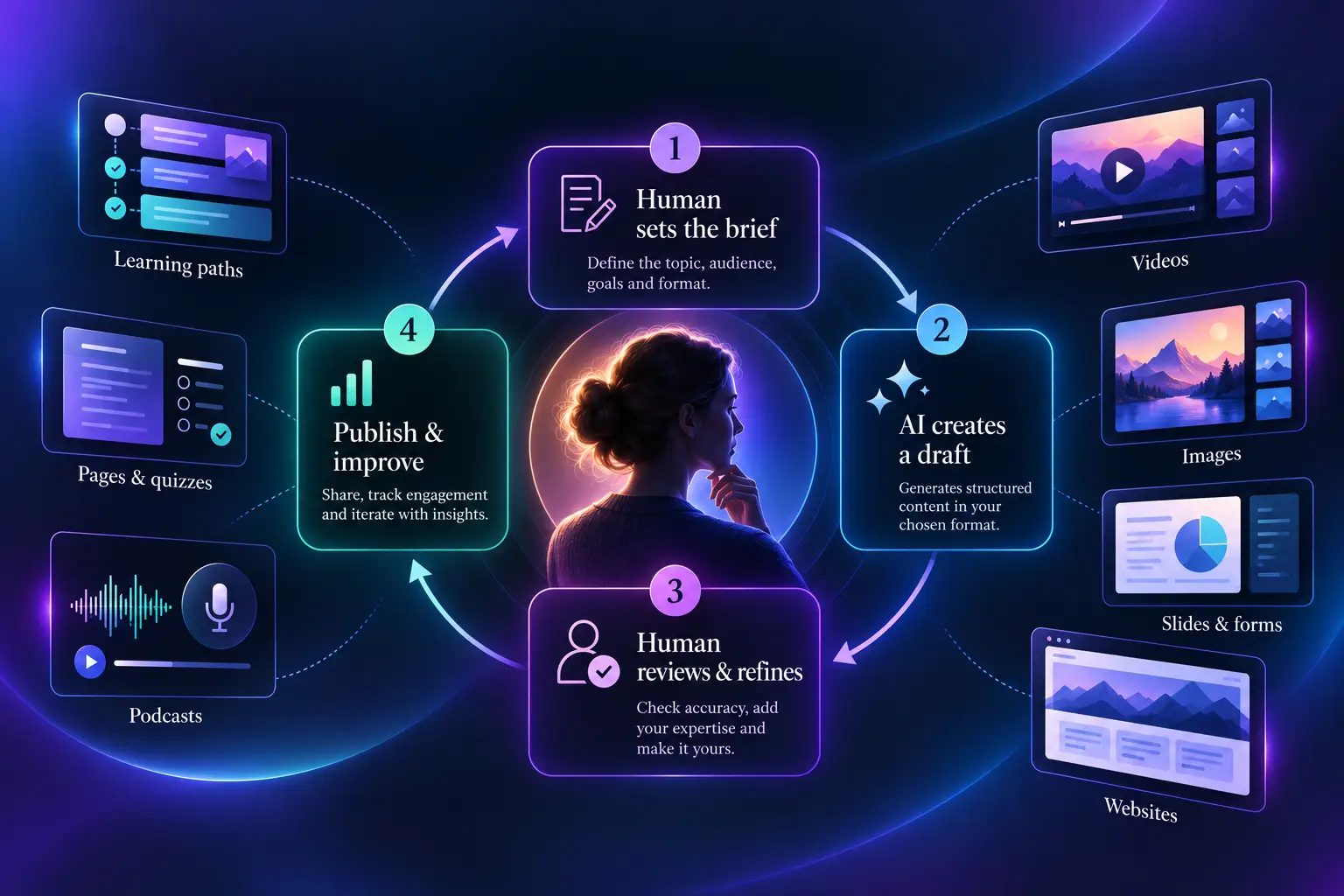
With Learner Journey’s AI-powered creation capabilities, much of this process can be accelerated.
An agentic workflow could take an employee handbook, existing training materials and a description of the desired learning outcomes, then generate a structured learning pathway.
It could create modules, draft learning materials, generate assessments and organise resources into a coherent programme.
The learning professional then reviews, refines and approves the output.
Their expertise has not become less valuable. Quite the opposite.
They can spend more time thinking about learning effectiveness, engagement and behavioural change rather than manually assembling content.
The instructional designer becomes the architect of learning rather than simply its producer.
3. Events that practically organise themselves
Imagine an organisation that runs hundreds of professional development events every year.
Its events are scattered across websites, spreadsheets, PDF brochures, Word documents and calendars.
Someone has to manually transfer all this information into an events management system.
With Learner Journey’s agentic event import workflows, that process can be dramatically accelerated.
An organiser can provide a website URL or upload a document containing upcoming events.
The workflow can identify:
Event titles and descriptions.
Dates and start times.
Locations and joining links.
Relevant event imagery.
Event categories and tags.
Registration information where available.
The organiser reviews the extracted information before importing the events into Learner Journey.
Instead of spending an afternoon manually creating dozens of events, they can potentially complete the process in minutes.
The organisation can devote more attention to attracting attendees, building communities and delivering valuable experiences.
4. Building digital experiences at extraordinary speed
For decades, creating websites and digital learning environments has been a relatively labour-intensive process.
There are design meetings, content workshops, copywriting, page construction and repeated revisions.
Agentic workflows change the economics of this process.
Within Learner Journey, organisations can use existing websites, documents and natural-language prompts to accelerate the creation of digital experiences.
They can:
Import existing website content.
Generate complete web pages.
Create individual website sections.
Transform documents into digital content.
Generate and refine content prompts.
Build branded learning environments.
Create learning community websites.
Generate supporting learning resources.
Work that previously required hours of manual production can, in suitable circumstances, be completed in minutes.
The barrier between having an idea and delivering that idea is becoming remarkably small.
And when the cost of experimentation falls, innovation accelerates.
The economics of tenfold productivity
Imagine a team of five people responsible for delivering professional development, managing events and maintaining a digital learning community.
Historically, their output has been constrained by the number of hours available in their working week.
Now imagine that those same five people can build learning pathways, create web pages, import events and generate supporting materials up to ten times faster.
They could deliver more programmes, serve more members, experiment with new propositions and respond more quickly to customer needs.
For suitable, repeatable workflows, tenfold productivity gains are a realistic ambition. They should, of course, be measured against actual delivery times, quality and the human oversight required.
The greatest opportunity is not simply reducing costs.
It is increasing organisational capacity.
What would your organisation do if it could produce ten times more without requiring ten times more people?
That is a fundamentally different strategic question.
The greatest bottleneck is human capability
There is, however, a problem.
Giving employees access to AI agents does not automatically make them effective at managing those agents.
Consider what happened when computers first entered the workplace. Organisations invested heavily in hardware and software, but they also had to invest in developing the skills of their workforce.
The same challenge exists today, only at a much greater pace.
Employees must understand how to give agents effective instructions, verify their outputs, manage permissions, protect sensitive information and recognise when human intervention is necessary.
An agent that can update a CRM must not have unrestricted access to every customer record.
An agent that generates learning materials must not publish inaccurate or misleading information without appropriate review.
An agent that imports events must recognise uncertainty rather than invent missing details.
Organisations need controlled environments, clear accountability, appropriate approval processes and a culture of responsible AI adoption.
The objective is not uncontrolled autonomy.
It is controlled delegation.
Learning becomes part of the work
This is where Learner Journey brings together two increasingly important capabilities.
The first is a collaborative workspace where organisations can develop their people, share knowledge, establish learning communities and train employees in responsible AI adoption.
The second is a collection of AI-powered creation capabilities and agentic workflows that allow people to put these new ways of working into practice.
Employees should not simply attend a course about AI agents and return to their desks.
They should learn by building workflows, experimenting with agents, sharing successful approaches and understanding the boundaries within which these technologies should operate.
Learning and working become increasingly interconnected.
The learning platform becomes more than a destination for courses. It becomes an environment for workforce transformation.
Built for humans. Designed for agents.
What makes Learner Journey particularly powerful is that it is not simply a platform with built-in AI workflows designed for humans. It is also an agent-friendly platform. Your own AI agents can access Learner Journey through authorised accounts, navigate its capabilities and undertake work on your behalf. Rather than manually building a digital experience, you can give your agent the desired outcome, your requirements and your instructions. The agent and Learner Journey can then work together to build websites, learning pathways, events, communities and digital content at breakneck speed. Imagine briefing an AI agent in the morning and reviewing an entire digital learning experience shortly afterwards. This is the shift from software as a tool to software as an active participant in the workforce. Humans provide the vision, direction and oversight. Agents provide the execution. Learner Journey provides the environment in which the two come together. The future is not simply AI-powered software. It is software that humans and AI agents can operate together.
A new form of industrial leadership
The first Industrial Revolution rewarded those who understood how to organise mechanical power.
The digital revolution rewarded those who understood how to organise information.
The agentic revolution will reward those who understand how to organise intelligence.
Leadership will increasingly involve designing systems in which people and agents work together, each contributing what they do best.
Machines bring speed, scale, consistency and the ability to process enormous amounts of information.
People bring judgement, empathy, creativity, accountability and purpose.
The organisations that successfully combine these capabilities will have a significant competitive advantage.
And the most important question for employers may no longer be:
How many people do we need to complete this work?
It may instead be:
How do we equip our people to manage the intelligence that can complete this work?
At Learner Journey, we believe the future belongs to organisations that can learn faster, adapt faster and execute faster.
The new industrial era has begun.
The workforce of tomorrow will not simply use intelligent machines. It will learn how to lead them.
Discover more at LearnerJourney.com.