Replace 5 tools with a single AI learning platform
The Strange Problem with Learning Technology - And Why AI Changes Everything

Founder, Learner Journey
Why the future of learning isn’t another platform. It’s bringing everything together.
Imagine you’re running a school, a professional association, or a training organisation.
You want to teach people something.
It sounds simple enough.
But before you’ve taught a single lesson, you might need five different pieces of software.
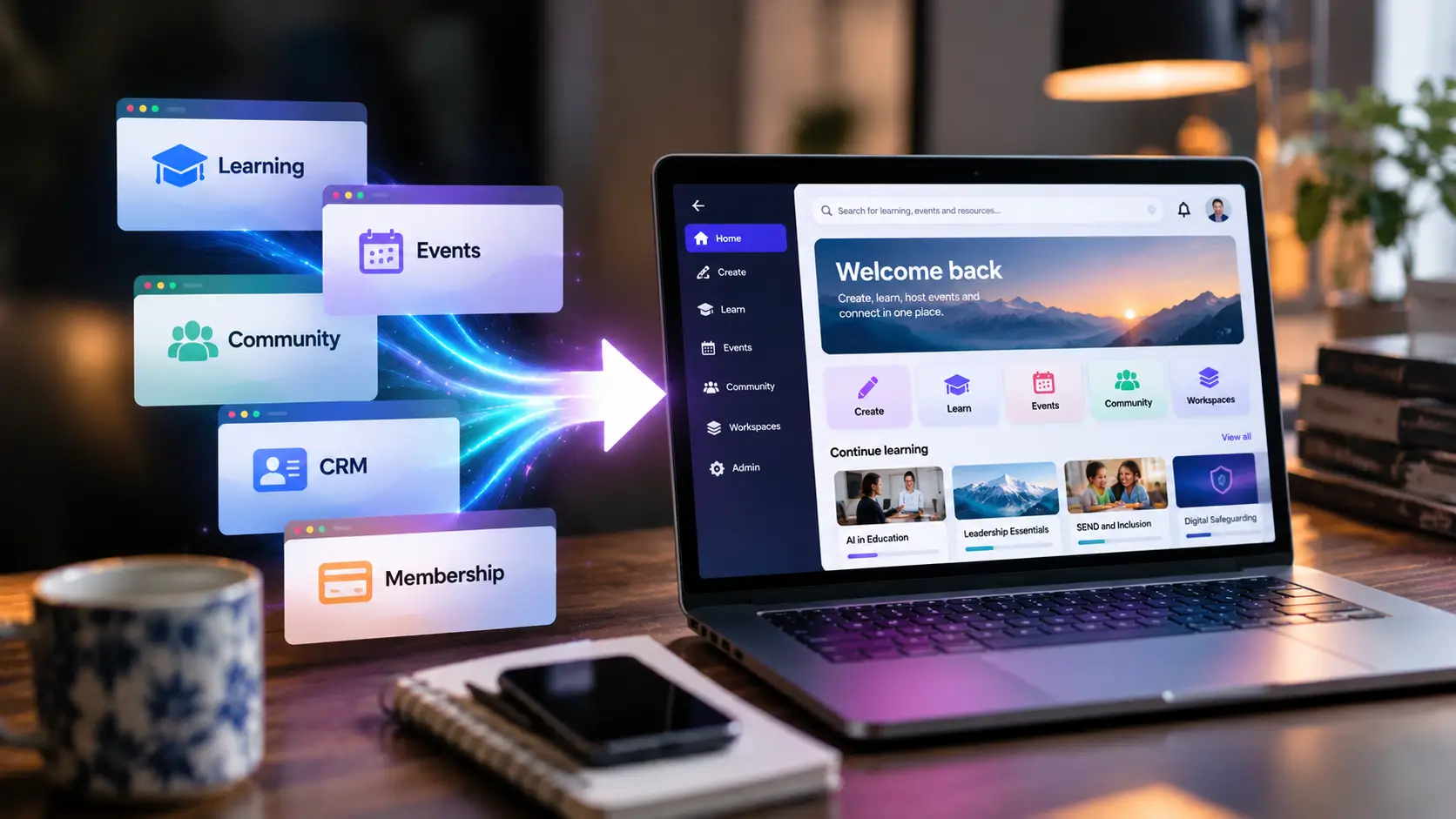
One to create the course. Another to deliver it. A third to organise events. A fourth to communicate with learners. And perhaps a fifth to manage memberships, payments and reporting.
Each system has its own login, its own database, its own subscription and its own peculiar way of doing things.
And somewhere in the middle of all this technology, something rather important gets forgotten.
The learner.
This is one of the great paradoxes of modern education technology.
We’ve never had more tools to help people learn. Yet we’ve made the process of delivering learning extraordinarily complicated.
What if we’ve been solving the wrong problem?
1. The Problem Isn’t a Lack of Technology
For the past twenty years, the learning technology industry has largely followed the same pattern.
Whenever organisations encounter a new challenge, someone builds another piece of software.
Need online courses? Buy a Learning Management System.
Need events? Find an events platform.
Need a community? Introduce a discussion platform.
Need customer relationships? Add a CRM.
Need artificial intelligence? Purchase an AI tool.
Individually, these products can be excellent.
Collectively, they create something rather less impressive: complexity.
It’s a bit like building a house where every room has been designed by a different architect.
The kitchen works. The bathroom works. The living room works.
But getting from one room to another requires a different key.
What organisations actually need isn’t more technology. They need fewer barriers between the things they’re trying to achieve.
That’s the thinking behind Learner Journey.
2. What Happens When Everything Connects?
Imagine a different approach.
You create a learning programme.
Within that programme, you publish courses, organise events, share videos, invite members and build a community.
Learners can attend an event, continue learning afterwards, ask questions, complete assessments and receive certificates.
Administrators can see their progress, communicate with them and manage the entire experience.
All within one platform.
This is what we’ve been building with Learner Journey.
It’s an AI-first learning platform that brings together five fundamental activities:
Creating educational content.
Delivering courses and assessments.
Organising events and conferences.
Building communities and memberships.
Understanding learner progress through analytics.
The important distinction isn’t simply that these features exist.
It’s that they work together.
An event can become the beginning of a learning journey. A course can lead to a community discussion. A community can create demand for another event.
Learning becomes something continuous rather than a collection of disconnected activities.
3. The Workspace: A Different Way of Thinking
One of the most interesting ideas behind Learner Journey is something we call a Workspace.
Think of a Workspace as a complete digital home for an organisation.
A school can create one.
A professional association can create one.
A business, charity, university or training provider can create one.
Each Workspace can have its own branding, website, learning content, events, community and members.
But here’s where it gets interesting.
Not every organisation wants to operate in the same way.
Some want their learning available to everyone.
Others need a private environment for employees or members.
Learner Journey supports both.
Public Workspaces allow organisations to share learning and resources openly.
Private Workspaces provide controlled access.
Organisations can also decide whether people register themselves or join by invitation.
These might sound like relatively small administrative decisions.
They’re not.
They determine whether learning can reach ten people, a thousand people or potentially millions.
And they give organisations the flexibility to grow without rebuilding their technology.
4. Artificial Intelligence Changes the Economics of Learning
For years, creating a sophisticated online learning environment required substantial investment.
You needed developers, instructional designers, administrators and technical specialists.
Even relatively straightforward projects could take months.
Artificial intelligence is beginning to change that equation.
With Learner Journey, AI can help organisations create learning materials, structure content and support learners.
But the most interesting development is the AI Tutor.
Traditional online learning has a fundamental limitation.
A learner reads something, watches something or completes a quiz.
If they don’t understand it, what happens next?
Often, very little.
Perhaps they repeat the material. Perhaps they email someone. Perhaps they simply move on.
An AI Tutor introduces a different possibility.
The learner can ask questions, explore difficult concepts and receive personalised explanations.
Instead of treating every learner identically, the system can respond to individual needs.
Of course, this introduces important responsibilities.
That’s why Learner Journey includes AI safety settings, controls and administrative oversight.
Organisations can establish boundaries around how AI is used and what it should be allowed to discuss.
The objective isn’t to replace teachers or trainers. It’s to make personalised support more accessible.
And that could have profound consequences for the cost and availability of education.
5. The Hidden Importance of Administration
There’s something curious about learning platforms.
Most demonstrations concentrate on what the learner sees.
Beautiful course pages. Engaging videos. Interactive assessments.
These things matter.
But anyone who has managed a large training programme knows that the real work often happens behind the scenes.
Who has completed their training?
Who hasn’t?
Which certificates have expired?
Which members belong to which groups?
Who needs a reminder?
What payments have been received?
Which programmes are actually working?
Learner Journey brings these activities into a single administration environment.
Organisations can manage members and cohorts, monitor progress through a gradebook, oversee compliance, issue certificates and customise communications.
There’s also a built-in CRM, membership management, payments, credits and analytics.
And organisations can configure their learning environment using different purpose templates and modules.
Why does this matter?
Because the cost of software isn’t simply the subscription.
It’s the time people spend operating it.
Every spreadsheet exported, every database reconciled and every manual reminder sent represents time that could have been spent doing something more valuable.
The most effective technology doesn’t simply automate work. It removes unnecessary work altogether.
6. From Learning Platform to Learning Business
Consider a professional association.
Traditionally, it might run conferences, sell memberships and provide professional development through entirely separate systems.
Now imagine those activities operating together.
Someone discovers an event.
They register and attend.
Afterwards, they’re offered a related learning programme.
They complete the programme and receive a certificate.
They join the association’s community.
Eventually, they become a paying member.
The organisation can understand that entire relationship.
Not as five separate transactions, but as one connected journey.
This is particularly relevant for organisations delivering Continuing Professional Development (CPD), professional memberships, conferences and training.
Learner Journey includes CRM, membership, payments and credits because learning increasingly overlaps with community, commerce and professional development.
And organisations can begin with a free plan before considering Premium or Pro options as their needs grow.
7. Why We Built School Anywhere
We’ve also been exploring what happens when you take this thinking beyond individual organisations.
One example is School Anywhere.
The idea is straightforward.
What if the UK National Curriculum could be made freely accessible online, organised into learning resources that pupils, teachers and families could explore without needing to register?
A little like Wikipedia, but structured around the curriculum.
Then imagine adding an AI Tutor for learners who want personalised support and progress tracking.
Suddenly, the distinction between a learning platform and an educational resource begins to disappear.
The platform isn’t simply delivering content.
It’s helping people discover, understand and build upon knowledge.
And the same underlying technology can support a school, a professional association, a training provider or an entire educational community.
That’s an exciting possibility.
8. The Next Generation of Learning Platforms
For much of the past two decades, educational technology has been about digitising existing processes.
We took classrooms and created virtual classrooms.
We took paper assessments and created online quizzes.
We took training records and created digital gradebooks.
These were useful improvements.
But artificial intelligence offers something fundamentally different.
It allows us to reconsider how learning is created, delivered, supported and managed.
The question is no longer simply:
How do we put our existing training online?
It’s becoming:
What would learning look like if we designed the entire experience around the learner, using the technology now available?
That’s the question we’re trying to answer with Learner Journey.
Not by adding another disconnected tool to an already crowded market.
But by bringing together the things that make learning valuable in the first place.
Content. Teaching. Events. People. Community. Progress.
All connected.
9. See Learner Journey in Action
We’ve created a short video demonstrating how the platform works.
It takes you through the Home dashboard, content creation, learning tools, media, communities and branded Workspaces.
You’ll also see how organisations can manage members, courses, events, AI Tutors, certificates, communications, CRM, memberships, payments and analytics.
And how they can get started for free.
The demonstration takes less than four minutes.
Because perhaps the most important thing about the next generation of learning technology is this:
Something that once required five platforms, multiple subscriptions and considerable technical expertise should now be possible in one place.
And it should be simple enough for almost anyone to use.
That’s what we’re building.