How to choose an AI-powered Learning Management System
Discover how AI is transforming learning management systems, making content creation and personalised experiences easier.
Founder, Learner Journey

Best AI-Powered Learning Management Systems in 2027
The learning management system is changing.
For years, LMS platforms were primarily places to upload courses, enrol learners, track completions and produce reports. They were useful systems of record, but they were rarely where learning itself came alive.
In 2027, that is no longer enough.
The rise of artificial intelligence is changing what organisations should expect from a learning platform. AI can help create content, support learners, analyse engagement, personalise experiences and dramatically reduce the administration involved in running learning programmes.
But simply adding an AI assistant to a traditional LMS does not make it an AI-first learning platform.
The best AI-powered learning management systems in 2027 will combine AI, learning, events, communities, knowledge and data in one place.
That is the thinking behind Learner Journey.
What Is an AI-Powered Learning Management System?
An AI-powered LMS uses artificial intelligence to make learning easier to create, manage and experience.
That can include generating learning content from prompts, creating quizzes and assessments, providing AI tutoring, helping administrators organise programmes, analysing learner activity and guiding individuals towards relevant learning.
The bigger opportunity, however, comes when AI has access to the wider learning journey.
If your courses are in one system, events in another, registrations in spreadsheets, discussions somewhere else and learner data spread across multiple platforms, AI only sees fragments of the picture.
Learner Journey takes a different approach.
It is an AI-first, all-in-one learning platform designed so that learning, events, communities, assessments, bookings, knowledge and learner activity can exist within the same environment.
That creates a much richer foundation for AI.
Why Having Your Learning Data in One Place Matters
Many organisations have accumulated a complicated learning technology stack.
They might use an LMS for courses, Eventbrite for events, Microsoft or Google Forms for registrations, Zoom or Teams for webinars, spreadsheets for attendance, another system for certificates and separate community tools for discussion.
Every individual system may work perfectly well.
The problem is the fragmentation between them.
When learning activity exists within Learner Journey, organisations can build a much more complete picture of participation and development.
Someone might attend an event, complete a learning path, take an assessment, ask the AI Tutor a question, participate in a community and receive a certificate.
Instead of those being six disconnected activities, they can form part of one learner journey.
That is where AI becomes particularly powerful.
Learner Journey: An AI-First Learning Platform
Learner Journey has been designed around a simple idea:
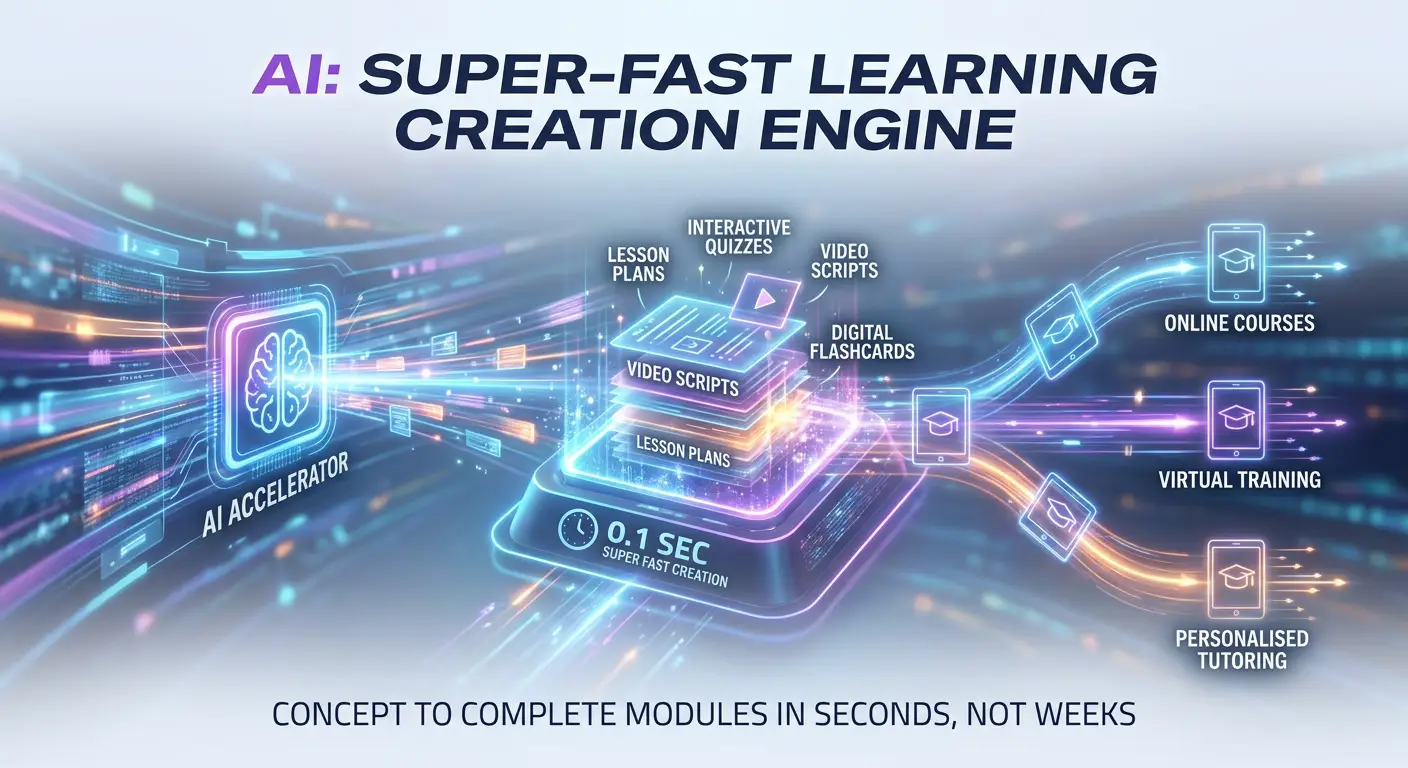
Make it extraordinarily fast to create learning communities, content and events — and use AI throughout the platform to reduce the work involved.
Rather than treating AI as an additional feature, AI is embedded throughout the experience.
Here are some of the main capabilities.
1. AI-Powered Learning Content
Creating good learning content traditionally takes time.
Learner Journey makes it possible to move from an idea or prompt to structured learning content far more quickly.
Users can create pages, quizzes, assessments, learning paths, slides, forms and games, incorporating video, audio, podcasts, images, documents and other resources.
Prompt-based creation means subject experts do not have to become instructional designers or learn complicated authoring software before they can start sharing their knowledge.
The outcome: organisations can turn internal expertise into structured learning faster and keep content current without creating an enormous content-production bottleneck.
2. Learning Paths
Learning rarely consists of one course.
Learner Journey enables organisations to create structured learning paths combining different types of content and activities into a coherent journey.
A learner might watch a video, read a resource, attend an event, complete an assessment and continue to another stage of development.
Progress can be tracked across the journey.
The outcome: learning becomes a progression towards capability rather than simply a catalogue of disconnected courses.
3. AI Tutor and Coach
One of the biggest opportunities for AI in learning is providing support at the moment somebody needs it.
Learner Journey includes an AI Tutor and Coach that can support learners through conversational interaction.
Instead of searching through folders, courses and documents, learners can ask questions and receive relevant assistance based on the information and learning available to them.
The AI experience can respect permissions, learner roles and progress, while guardrails help organisations control the experience.
The outcome: learners can get support when they need it, while organisations can scale guidance without requiring a human trainer to answer every question.
4. Events and Professional Development
Learning does not only happen inside courses.
Workshops, conferences, webinars, CPD sessions and face-to-face events are often some of the most valuable learning experiences an organisation provides.
Learner Journey therefore includes comprehensive event management.
Organisations can create and promote events, manage registrations, set capacity limits, operate waiting lists, issue invitations, sell tickets, use discount codes, collect invoice and purchase-order information and manage attendees.
Events can also connect to certificates and the wider learner record.
The outcome: organisations can replace fragmented combinations of event platforms, forms, spreadsheets and manual administration with one connected process.
5. Learning Communities
Some of the most valuable learning happens between people.
Learner Journey is designed to help organisations build learning communities, rather than simply distribute content.
A branded workspace can become a destination where members, employees, teachers, professionals or learners return to discover resources, participate in development and connect around shared interests.
Learning therefore becomes something people participate in rather than something that is periodically assigned to them.
The outcome: stronger engagement, knowledge sharing and an ongoing relationship between the organisation and its learners.
6. Branded Workspaces
Different audiences often need different learning environments.
Learner Journey enables organisations to create branded workspaces for particular communities, programmes, organisations or audiences.
A professional body could create a member learning environment. A Multi-Academy Trust could create a professional development workspace for its schools. A training organisation could create separate environments for different programmes or customers.
The workspace can reflect the organisation’s own identity while bringing together its content, events and community.
The outcome: organisations can create focused learning destinations without commissioning a separate platform every time they launch a new programme or community.
7. Quizzes and Assessments
AI-powered learning still needs evidence that people have understood and applied what they have learned.
Learner Journey supports quizzes and assessments alongside other learning activities.
These can be incorporated directly into learning paths rather than managed through separate assessment systems.
The outcome: organisations can move beyond simply recording attendance or content completion towards demonstrating understanding and progress.
8. Certificates and Recognition
Recognition matters, particularly in professional development.
Learner Journey can issue certificates for learning paths, quizzes and events.
Certificates can be branded, emailed to participants and verified. Learners can also share achievements more widely, including adding appropriate credentials to LinkedIn.
The outcome: learners receive tangible evidence of development while organisations reduce the manual administration associated with CPD certification.
9. Forms and Data Collection
Learning programmes generate data.
Feedback forms, registrations, applications, assessments and surveys are often created using separate form tools, resulting in yet another disconnected dataset.
Learner Journey includes forms as part of the platform.
The outcome: organisations can collect information closer to the learning experience and reduce their dependence on disconnected forms and spreadsheets.
10. Bookings
Learning and development frequently involves conversations as well as content.
Learner Journey includes booking functionality, allowing people to arrange appointments or sessions through personalised booking pages.
Availability can be managed alongside calendar commitments, with optional payments and online meeting creation.
This can support mentoring, coaching, consultations, office hours and one-to-one learning.
The outcome: human interaction can become another connected part of the learner journey rather than a separate administrative process.
11. Jobs and Opportunities
Development should ultimately lead somewhere.
Learner Journey can also connect learning communities with jobs and opportunities, including role listings and applications.
For organisations building professional communities, this creates an opportunity to connect learning with progression.
The outcome: the platform can support the journey from learning and capability development through to real opportunities.
Prompt-Based Learning Changes Who Can Create Learning
One of the most important changes AI brings to learning technology is not simply personalisation.
It is creation.
Historically, building digital learning often required specialist authoring tools, instructional designers and lengthy production processes.
Prompt-based learning changes that.
A subject expert can start with what they know:
“Create a short learning module explaining safeguarding responsibilities for new school governors.”
AI can help turn that knowledge into structured digital learning.
The expert remains responsible for the quality and accuracy of the material, but the mechanical work required to move from an idea to a learning experience can be dramatically reduced.
That opens learning creation to many more people inside an organisation.
From LMS to Learning Ecosystem
This is perhaps the biggest distinction between traditional learning management systems and the next generation of AI-powered platforms.
A traditional LMS asks:
What courses has this person completed?
An AI-first learning platform can begin asking much richer questions:
What is this person trying to achieve?
What have they already learned?
Which events have they attended?
What do they understand?
Where might they need help?
What should they do next?
The quality of those answers depends heavily on the quality and breadth of the underlying data.
That is why an all-in-one architecture matters.
AI Works Better When the Learning Journey Is Connected
There is a fundamental difference between adding AI to individual products and building an environment where AI can work across a connected learning experience.
Imagine that an organisation has:
2,000 members
100 learning resources
30 annual events
20 learning paths
thousands of event registrations
assessment results
certificates
learner questions
community activity
professional development records
If all of this sits in disconnected systems, much of its potential value is lost.
Bring those activities together and the organisation begins to build a much richer understanding of its learning community.
That creates opportunities not simply to automate administration, but eventually to help people navigate their own development more intelligently.
Who Is Learner Journey For?
Learner Journey can support organisations that need to combine learning, events and communities, including professional bodies and membership organisations, Multi-Academy Trusts, teaching school hubs, universities and colleges, training providers, charities, employers, associations and professional development organisations.
The common requirement is not necessarily “we need another LMS.”
It is often:
“We need a better way to bring our learning community together.”
What Should You Look for in an AI-Powered LMS in 2027?
When comparing AI-powered learning management systems, don’t judge them purely on whether they have an AI chatbot.
Ask deeper questions.
Can AI help you create learning?
Can it support learners?
Can the platform manage live and digital learning?
Can it manage events?
Can you create branded communities?
Can you collect data and assessments?
Can achievements be recognised?
Can different activities form part of one learner journey?
And, crucially:
Does the data live together, or are you still connecting five or six separate systems?
The Future Is AI-First — But Also Connected
Artificial intelligence will transform learning platforms.
But AI alone is not the answer.
The bigger opportunity is combining AI with a connected environment where learning, people, events, communities and data live together.
That is what Learner Journey is designed to do.
It is an AI-first, all-in-one learning platform that makes it remarkably fast to create learning, launch branded communities, organise events and support people throughout their development.
Instead of adding another tool to an already fragmented learning technology stack, organisations can start bringing the entire learner journey together.
And when the data, learning and community are connected, AI becomes much more useful.
Create learning. Build communities. Run events. Support learners. Understand the journey. All in one place.