Beyond ChatGPT: Why Organisations Need a Safe, Collaborative AI Workspace
Bringing AI creativity, collaboration, safeguarding and governance together in one place with Learner Journey.
Bringing AI creativity, collaboration, safeguarding and governance together in one place with Learner Journey.
Artificial intelligence is transforming the way we work, learn and create. From generating presentations and producing podcasts to designing images, developing training materials and building entire learning experiences, AI is opening up extraordinary opportunities.
But there’s a problem.
Most people are experimenting with AI individually, often outside the visibility and control of their organisation.
Teachers are using personal AI accounts to prepare lessons. Employees are experimenting with different AI tools to create content. Students are discovering powerful generative AI applications independently. Training teams are subscribing to multiple platforms, each with its own policies, permissions and approach to data protection.
While this experimentation is encouraging, it creates a significant challenge for organisations.
How do you encourage people to develop AI skills and embrace creativity while maintaining appropriate safeguarding, oversight and governance?
That’s exactly the challenge we’ve been addressing with Learner Journey.
Moving Beyond Private AI Conversations
Most generative AI tools are designed around an individual experience.
You open a chatbot, type a prompt, receive a response and continue working privately.
That approach can be useful, but it doesn’t necessarily encourage collaboration, shared learning or organisational oversight.
Imagine a different approach.
Instead of teachers experimenting with AI independently, an entire teaching team could work together in a shared AI environment.
Instead of employees creating AI-generated content on disconnected platforms, colleagues could collaborate on presentations, learning materials, videos and creative projects within a single workspace.
Instead of organisations having little visibility into how AI is being used, administrators could establish clear rules, permissions and safeguards.
Learner Journey brings AI into a shared, collaborative workspace where creativity and learning can happen together.
AI becomes something people can explore, understand and use collectively, rather than something happening behind closed doors.
A Safe AI Workspace with Built-In Guardrails
One of the biggest barriers to AI adoption, particularly in education, is the question of safety.
Schools, multi-academy trusts, universities and employers need confidence that AI is being used appropriately.
Simply giving everyone access to an AI chatbot isn’t enough.
Organisations need safeguards that reflect their responsibilities, policies and the people using the technology.
Learner Journey has been designed with this in mind.
1. Safeguarding and AI Guardrails
Learner Journey provides workspace-level AI safety controls, helping organisations establish boundaries around how AI can be used.
Administrators can configure access to AI capabilities, control permissions and determine which features are appropriate for their users.
For example, a school might want teachers to experiment with AI-generated learning resources while restricting particular capabilities for younger learners.
A training organisation might allow AI-assisted content creation while applying tighter controls to how its AI tutor responds to questions.
These safeguards help organisations move away from unmanaged AI experimentation towards a more structured and responsible approach.
2. AI Kill Switches: Staying in Control
Sometimes organisations need to act quickly.
A safeguarding concern might arise. A particular AI feature might need reviewing. An organisation may want to introduce new capabilities gradually rather than enabling everything immediately.
Learner Journey gives administrators control over individual AI capabilities.
These include:
AI-generated text and learning content.
AI image generation and editing.
AI video creation.
AI audio and music generation.
AI tutoring and coaching.
AI-assisted recruitment features.
Other AI-powered workspace capabilities.
These controls effectively act as AI kill switches, allowing administrators to disable particular capabilities without shutting down the entire learning environment.
For organisations introducing AI for the first time, this is particularly valuable.
They can start small, establish confidence and expand access as their AI policies and staff capabilities develop.
3. Audit Trails, Transparency and Accountability
One of the challenges with employees using their own AI accounts is that organisations have limited visibility into what’s being created.
Who generated a particular piece of content?
When was AI used?
Which materials were produced with AI assistance?
How is AI being incorporated into learning and training resources?
Learner Journey is designed to support greater transparency and accountability around AI-generated content.
AI labelling helps identify content created with AI, while workspace administration, activity information and AI conversation management provide additional oversight.
This helps organisations understand how AI is being used and establish clearer accountability.
Rather than AI-generated materials appearing without context, organisations can work towards a culture in which AI assistance is acknowledged and understood.
The objective isn’t to discourage AI use. It’s to make AI use visible, responsible and trustworthy.
Auditability is also an important part of building confidence among school leaders, safeguarding teams, governors and organisational decision-makers.
AI Should Make People More Creative, Not Less
Much of the conversation around AI focuses on automation and productivity.
How many hours can AI save?
How quickly can it produce a document?
How much administrative work can it eliminate?
These are important questions, but they overlook one of AI’s most exciting possibilities.
AI can help people become more creative.
Someone who has never designed a presentation can now communicate ideas visually.
A teacher who has never produced a podcast can create engaging audio learning materials.
A subject expert who isn’t a graphic designer can develop illustrations and visual explanations.
An employee who has never built an online course can start creating interactive learning experiences.
AI can lower the technical barriers between having an idea and bringing it to life.
Learner Journey brings these creative capabilities together in one connected environment.
One Workspace. Multiple AI Creative Tools.
Rather than switching between numerous applications, Learner Journey allows people to create and develop different types of content within the same platform.
AI-Powered Presentations and Slides
Turn ideas, topics and learning objectives into engaging presentations.
Teachers can develop classroom resources, trainers can create workshop materials, and employees can build presentations to communicate complex ideas.
AI can help users get started, structure their thinking and develop creative content.
Podcasts and Audio Learning
Audio is an increasingly valuable way to communicate information and support learning.
Learner Journey brings podcast and audio creation into the learning environment, allowing users to develop engaging resources that people can listen to wherever they are.
Imagine turning a complex topic into an accessible audio explanation or creating supplementary listening materials for a training programme.
AI Video Creation
Video can make learning more engaging, visual and accessible.
With AI-assisted video creation, users can explore new ways of explaining concepts, telling stories and presenting information.
This opens up creative opportunities for people who might not have traditional video production skills.
AI Image Generation and Photo Editing
Visual communication is central to effective learning.
Learner Journey enables users to generate images with AI and edit existing photographs.
This can help teachers create illustrations, training teams produce visual resources and employees communicate their ideas more effectively.
Instead of searching through multiple stock-image libraries or switching between design applications, users can incorporate visual creativity directly into their work.
Learning Pages and Interactive Content
One of Learner Journey’s most powerful capabilities is connecting AI creativity directly to learning.
Users can create learning pages, develop explanations, structure information and combine different media into engaging educational resources.
Rather than producing disconnected AI-generated documents, people can create content that becomes part of a structured learning experience.
Learning Paths, Quizzes and Assessments
AI-generated content becomes even more valuable when it forms part of a complete learning journey.
Learner Journey enables organisations to bring together:
Learning pages and structured courses.
AI-generated presentations.
Podcasts, videos and images.
Quizzes and assessments.
Interactive learning activities.
Learning paths and progress tracking.
AI tutoring and coaching.
The result is a connected environment where creativity, teaching, learning and assessment can work together.
You’re not simply generating content with AI. You’re turning that content into meaningful learning experiences.
Teaching AI Literacy Through Practical Experience
There’s an important difference between teaching people about artificial intelligence and teaching them how to use it effectively.
AI literacy isn’t simply knowing what ChatGPT is or understanding how a large language model works.
It’s about developing practical skills.
How do you write an effective prompt?
How do you improve an AI-generated response?
How do you recognise when AI might be wrong?
How do you evaluate the quality of AI-generated content?
How do you use AI ethically and responsibly?
How do you combine human creativity with machine-generated ideas?
And how do you decide when AI shouldn’t be used at all?
Learner Journey provides an environment where these skills can be developed through practical experience.
A teacher might experiment with generating a learning resource and then critically evaluate the output with colleagues.
A group of students might explore how different prompts produce different creative results.
An employee might learn how to use AI to develop a presentation, create a video or design a training activity.
By making AI tools available within a governed learning workspace, organisations can encourage experimentation while maintaining appropriate boundaries.
The best way to develop AI literacy is to give people opportunities to use AI, question it, improve its outputs and learn from one another.
From Shadow AI to Organisational AI Governance
Many organisations are already experiencing what is sometimes called shadow AI.
This happens when individuals adopt AI tools independently, without formal organisational approval or oversight.
It might involve employees using personal AI subscriptions, teachers uploading materials to external platforms or departments purchasing different AI services without a coordinated strategy.
The result can be fragmented technology, inconsistent policies, unnecessary costs and potential safeguarding or data protection risks.
Banning AI entirely is unlikely to be a sustainable solution.
People want to use these tools because they can be genuinely useful.
A better approach is to provide an approved environment where people can experiment responsibly.
Learner Journey offers organisations a way to bring AI capabilities together under shared governance.
Administrators can manage which features are available, establish safety settings, control access to AI providers and configure how AI tutoring and other capabilities operate.
Organisations can also introduce AI gradually, developing their policies and confidence alongside their users’ skills.
This creates a more joined-up approach to AI adoption.
Instead of dozens of disconnected tools and individual accounts, there is a common environment for learning, creating and collaborating.
Collaboration Is the Missing Ingredient in AI Adoption
One of the greatest opportunities for AI in education and the workplace is collective learning.
When people experiment with AI privately, much of that learning stays with the individual.
Someone discovers a particularly effective way to create a presentation, but their colleagues never see it.
A teacher develops an innovative learning activity, but the approach isn’t shared across the school.
An employee finds a creative application for AI, but the wider organisation doesn’t benefit.
A collaborative AI workspace changes this dynamic.
Ideas, resources and learning experiences can be shared and developed within a common environment.
Teams can build on one another’s work.
Organisations can develop common approaches to prompting, content creation and responsible AI use.
And leaders can encourage a culture in which people openly discuss both the opportunities and limitations of AI.
The real value of AI isn’t simply making individuals more productive. It’s helping organisations become collectively more creative, capable and knowledgeable.
A Practical Approach for Schools and Multi-Academy Trusts
For schools and multi-academy trusts, responsible AI adoption presents a particularly important challenge.
Leaders want staff to benefit from AI, but they also have responsibilities around safeguarding, data protection, curriculum quality and professional standards.
Learner Journey can provide a shared environment for developing AI skills across a school or trust.
For example, a multi-academy trust could use the platform to:
Introduce staff to AI in a controlled environment.
Establish consistent AI policies and permissions.
Provide practical AI literacy training.
Encourage collaborative resource creation.
Develop AI-supported CPD programmes.
Share effective teaching resources between schools.
Create presentations, podcasts and learning materials.
Monitor AI activity through available administration tools.
Restrict or disable AI capabilities when necessary.
Rather than leaving individual schools or teachers to navigate AI adoption independently, a trust can develop a coordinated approach.
This supports both innovation and responsible leadership.
Equally Valuable for Employers and Training Organisations
The same principles apply beyond education.
Employers want staff to become more confident and capable with AI.
Professional bodies want to help members understand how AI is changing their industries.
Training providers want to create engaging resources without requiring specialist production skills.
Universities want to encourage experimentation while maintaining academic standards.
Learner Journey brings these needs together.
Organisations can develop AI literacy programmes, create learning resources, encourage collaboration and introduce practical AI tools within a common environment.
Importantly, AI becomes part of the learning process itself.
People don’t just complete a course about AI.
They use AI to create, explore, experiment and demonstrate what they’ve learned.
Human Creativity, Supported by AI
There is a concern that AI could make people less creative by encouraging them to accept machine-generated answers without thinking critically.
That is a genuine risk if AI is used passively.
But it doesn’t have to work that way.
Used well, AI can become a creative partner.
It can help people explore ideas they might not otherwise have considered.
It can help turn rough concepts into something tangible.
It can give people the confidence to experiment with formats and media they have never used before.
And it can make creative tools accessible to people who don’t have specialist technical skills.
The key is to encourage people to remain actively involved.
They should question AI outputs, improve them, personalise them and apply their own judgement.
Learner Journey is built around the idea that AI should support human learning and creativity, rather than replace them.
The Future of AI Is Collaborative, Creative and Governed
As artificial intelligence becomes part of everyday education and work, organisations face an important choice.
They can allow AI adoption to happen independently, with individuals using disconnected tools and developing their own approaches.
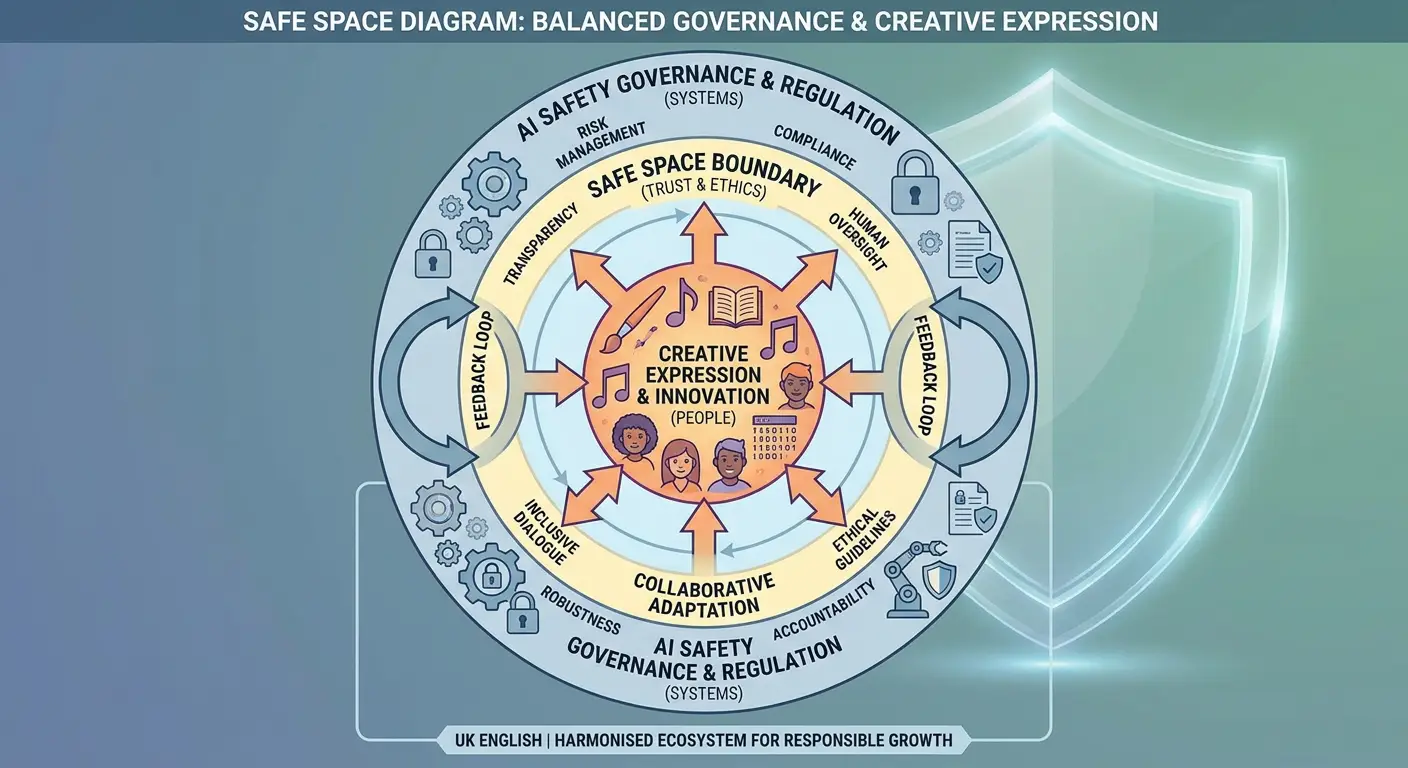
Or they can create a shared environment that encourages innovation while providing the governance and safeguards needed to use AI responsibly.
We believe the second approach offers far greater long-term value.
Learner Journey brings together three essential elements:
Safety: Safeguarding controls, configurable AI permissions, feature-level kill switches, transparency and administrative oversight.
Creativity: AI-powered slides, podcasts, videos, images, photo editing, learning pages and interactive learning experiences.
Collaboration: A shared workspace where people can develop AI skills, create resources, exchange ideas and learn together.
These capabilities help organisations move beyond isolated AI experimentation towards a more coordinated, creative and responsible approach.
Because the future of AI shouldn’t be about everyone sitting alone, prompting privately.
It should be about people learning together, creating together and using AI confidently within an environment they can trust.
That’s what we’re building with Learner Journey.
Discover a Safer, More Creative Way to Use AI
Whether you’re a school, multi-academy trust, university, training provider or employer, Learner Journey can help you introduce AI in a more structured and collaborative way.
Give your people the freedom to experiment and create, while maintaining the oversight and controls your organisation needs.