How Learner Journey's AI Tutor personalises your study
The AI Tutor module in is an intelligent, personalised learning assistant that helps people understand content, ask questions and develop skills.
The Learner Journey AI Tutor is a personalised AI learning assistant built directly into the Learner Journey platform.
Rather than simply giving learners access to courses and content, it allows them to ask questions, explore topics, receive explanations, practise their knowledge and get guidance on what to learn next.
The core idea is simple:
Every learner can have their own AI Tutor, while the organisation remains in control of the knowledge, permissions and learning experience.
How It Works
The AI Tutor sits across the learning experience in Learner Journey.
It can work with content such as:
Pages, Learning Paths, Quizzes, Assessments, Documents, Resources, Videos and Learning Content
Instead of searching through large amounts of content, the learner can simply ask a question.
For example:
Learner:
“Can you explain the difference between a safeguarding concern and an immediate child protection risk?”
AI Tutor:
“Both involve protecting children, but there is an important distinction…”
The Tutor can explain the concept, provide examples and point the learner towards relevant supporting material.
The objective isn’t simply to provide an answer.
It is to help the learner understand the subject and decide what to do or learn next.
Grounded in Your Organisation’s Knowledge
One of the most important features of the AI Tutor is that it can be grounded in the organisation’s own learning content.
Rather than operating as a completely separate general-purpose chatbot, the Tutor can use the resources available within the Learner Journey workspace.
This could include:
Training materials
Policies
Guidance
Learning pages
Courses
Professional development resources
Assessments
Uploaded documents
Where appropriate, the Tutor can cite the source material used to generate an answer.
This gives the learner somewhere to go to explore the subject in greater depth and provides greater confidence about where the information has come from.
Personalised to the Learner
The bigger opportunity is personalisation.
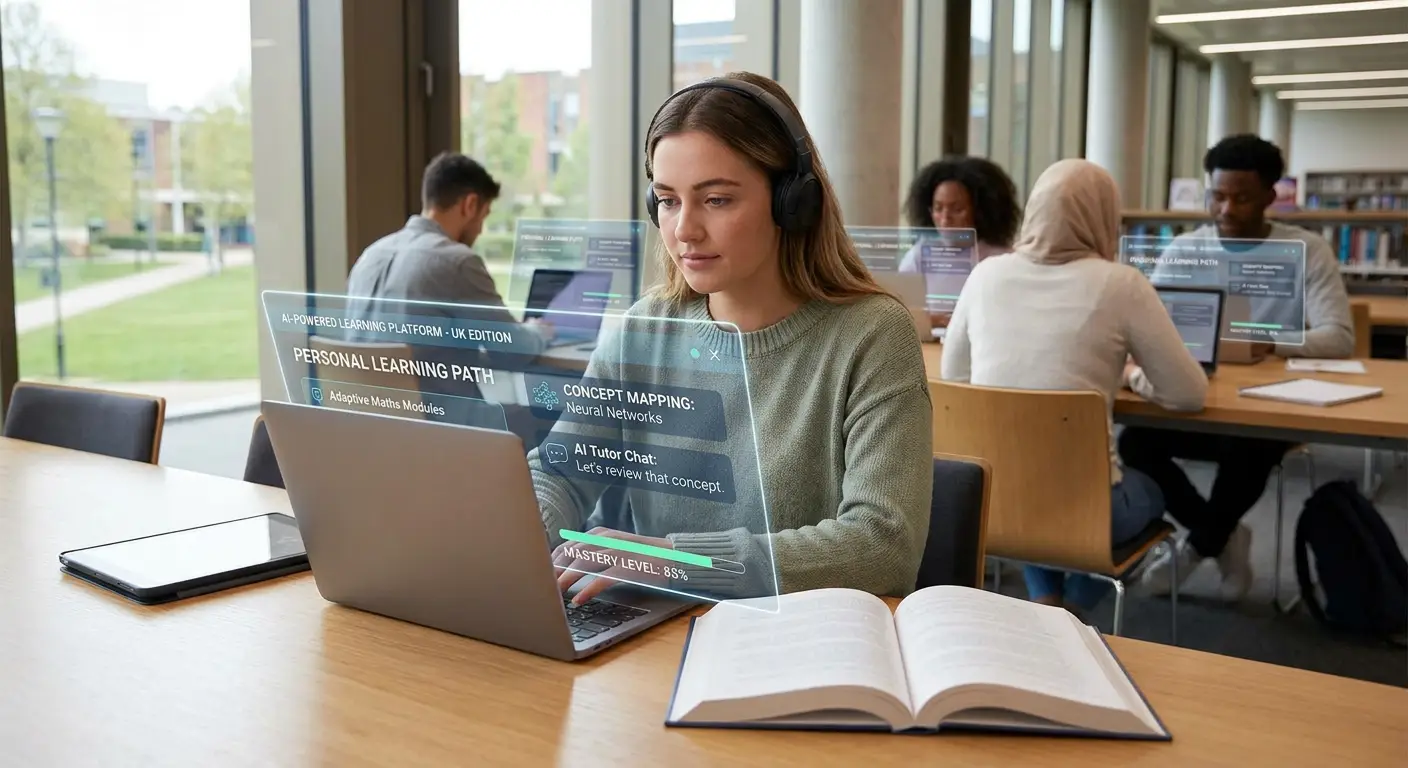
The AI Tutor can use the context available about the learner and their learning journey to make its support more relevant.
For example, a learner might have:
Completed: Safeguarding Fundamentals
Quiz score: 68%
Weak area: Recognising neglect
Current path: Advanced Safeguarding
Outstanding activity: Scenario Assessment
Instead of providing generic safeguarding information, the AI Tutor can concentrate on the areas where that individual needs additional help.
This creates the potential for every learner to have a different learning experience based on their needs.
Conversational Learning
Traditional learning platforms generally work like this:
Find course → Open course → Consume content → Complete quiz
The AI Tutor introduces another way of learning:
Ask → Understand → Question → Practise → Reflect → Continue
Learners can ask follow-up questions naturally.
For example:
“Explain that more simply.”
“Give me an example from a primary school.”
“Why is that important?”
“Test me on this.”
“What did I get wrong?”
“What should I learn next?”
This turns learning into a conversation rather than simply the consumption of content.
AI-Powered Practice
The AI Tutor can also support active learning.
Instead of simply explaining something, it can challenge the learner.
For example:
Quick Knowledge Check
A pupil tells you they are experiencing physical abuse at home. What should you do first?
A. Investigate the allegation yourself
B. Immediately follow the organisation’s safeguarding procedure
C. Wait to see whether the pupil mentions it again
D. Contact the pupil’s parents
The learner answers and the AI Tutor can explain why the answer is right or wrong.
This allows AI to become part of the learning process rather than simply a search tool.
Learning Recommendations
Because the AI Tutor sits within Learner Journey, it can connect conversations with learning opportunities.
A learner asking about a particular subject could be directed towards:
A relevant page
→ A learning path
→ A video
→ An assessment
→ An event or workshop
→ Another learning resource
This creates a much more connected learning experience.
Instead of learners having to work out where to go next, the platform can help guide them.
Voice
The AI Tutor can also support voice interaction.
This means the learner doesn’t necessarily need to type questions.
They can have a more natural conversation with their Tutor, which could be particularly valuable for:
Coaching
Reflection
Language learning
Interview preparation
Leadership development
Professional development
Revision
Accessibility
The long-term experience becomes closer to having a personal coach or tutor available whenever the learner needs help.
Administrator Controls
Organisations need control over how their AI Tutor operates.
The Tutor administration area therefore centres around four areas:
Settings
Control how the Tutor behaves.
This can include its instructions, knowledge sources, permissions, tone, availability and guardrails.
Conversations
Understand how learners are interacting with the Tutor.
Administrators can review appropriate conversation information, feedback and issues subject to the organisation’s permissions and policies.
Analytics
Understand Tutor adoption and engagement.
For example:
How many learners are using it?
How frequently?
What are people asking?
Which subjects generate the most questions?
Where are learners struggling?
Insights
This is potentially one of the most powerful areas.
Individual conversations can reveal organisation-wide learning needs.
If hundreds of employees repeatedly ask questions about the same concept, that tells the learning team something important.
There may be:
A knowledge gap
A confusing policy
A poorly understood concept
Missing learning content
A new training requirement
AI therefore doesn’t just help the learner.
It can help the organisation understand what its people need to learn.
Permissions and Guardrails
The AI Tutor is designed to respect the permissions within the Learner Journey workspace.
A learner should only receive information they are entitled to access.
This becomes particularly important where a workspace contains content for different:
Roles
Departments
Schools
Organisations
Membership levels
Professional groups
Learning cohorts
The organisation remains in control of the learning environment.
From AI Tutor to AI Coach
The longer-term opportunity is much bigger than creating a chatbot inside an LMS.
The Tutor can increasingly understand:
Who are you?
↓
What are you trying to achieve?
↓
What have you already learned?
↓
What do you understand?
↓
Where are your knowledge gaps?
↓
What should you learn next?
↓
Has your capability actually improved?
That turns the AI Tutor into something closer to an AI learning coach.
Why This Matters
Most traditional learning platforms are primarily designed around content management.
Upload a course.
Assign it.
Track completion.
Learner Journey can take a different approach.
The platform combines:
Learning Content
Events
Assessments
Learning Paths
Certificates
Communities
Learner Progress
AI Tutor
All within the same learning environment.
That gives the AI Tutor much richer context than an isolated chatbot.
The Bigger Learner Journey Proposition
The AI Tutor helps move Learner Journey from being simply somewhere people go to complete training towards somewhere people go when they want to learn.
The difference is significant.
Traditional LMS
“Here are the courses you need to complete.”
Learner Journey
“What are you trying to learn?”
And increasingly:
“Based on what I know about you, here’s what I think you should learn next.”
That is where the AI Tutor becomes strategically important.
Learner Journey isn’t simply using AI to create learning content faster. It is using AI to create a more personalised, conversational and continuously guided learning journey.